
Positive displacement pumps occupy a critical position in process industries where the precise metering of viscous fluids, the handling of shear-sensitive materials, or the requirement for pulsation-free flow at moderate to high pressures rules out centrifugal pump technology. Among the most widely used positive displacement designs, the gear pump and the twin screw pump serve complementary segments of the fluid handling market, each with a distinct mechanism and a characteristic set of applications that reflect the design’s strengths. Understanding the operating principles, the application suitability, and the selection criteria for rotary gear pump and twin screw configurations helps engineers and procurement teams specify the right pump for demanding industrial requirements.
What is a gear pump and how does it work?
A gear pump is a positive displacement pump that moves fluid through the intermeshing action of two or more gears rotating within a close-tolerance casing. The basic rotary gear pump principle involves the creation of an expanding volume on the inlet side as gear teeth disengage, drawing fluid into the pump, and a reducing volume on the outlet side as gear teeth mesh, displacing fluid out of the pump under pressure. Because the displacement per revolution is fixed by the gear geometry, the flow rate is directly proportional to the rotational speed, which makes gear pumps inherently accurate metering devices in addition to the primary function as fluid transfer pumps.
The two principal gear pump configurations are:
- External gear pump: two externally toothed gears of equal size mesh together within a close-tolerance casing. One gear is driven by the motor shaft and drives the other through the meshing teeth. Fluid is carried in the spaces between the gear teeth from inlet to outlet around the outside of both gears. The external gear pump is the most common configuration, used across lubricating oil circuits, hydraulic power packs, chemical metering, and fuel transfer applications
- Internal gear pump: one externally toothed inner rotor meshes with a larger internally toothed outer rotor within an eccentric casing. The internal gear pump working principle creates a crescent-shaped cavity between the two rotors that carries fluid from the inlet port to the outlet port as the rotors turn. Internal gear pumps produce lower shear than external gear designs and handle a wider viscosity range, including highly viscous products that would not pass through the tighter clearances of an external gear pump
What is the internal gear pump working principle in detail?
The internal gear pump working principle is worth understanding in detail because it explains why the configuration is preferred for viscous, shear-sensitive, and abrasive fluid applications. As the inner rotor turns, its teeth mesh progressively with the outer rotor teeth, creating expanding cavities on the suction side that draw fluid in. The fluid is carried in the crescent-shaped space between the inner and outer rotors as both rotate, without the fluid passing through the gear mesh. On the discharge side, the cavities reduce as the teeth re-engage, displacing the fluid out through the discharge port.
The key advantages of the internal gear pump design relative to external gear pumps are:
- Lower shear: the fluid travels around the outside of the rotating assembly rather than through a tight gear mesh, which is important for polymers, food products, and other materials that degrade under high shear
- Wider viscosity range: the crescent design accommodates viscosities from thin solvents to heavy residual oils and bitumen, far exceeding the viscosity range of external gear designs whose clearance limitations restrict operation with very thick fluids
- Self-priming capability: the positive suction created by the expanding inlet cavity allows internal gear pumps to self-prime reliably, which is valuable in applications where the pump may run dry on start-up
What are twin screw pumps and where are they used?
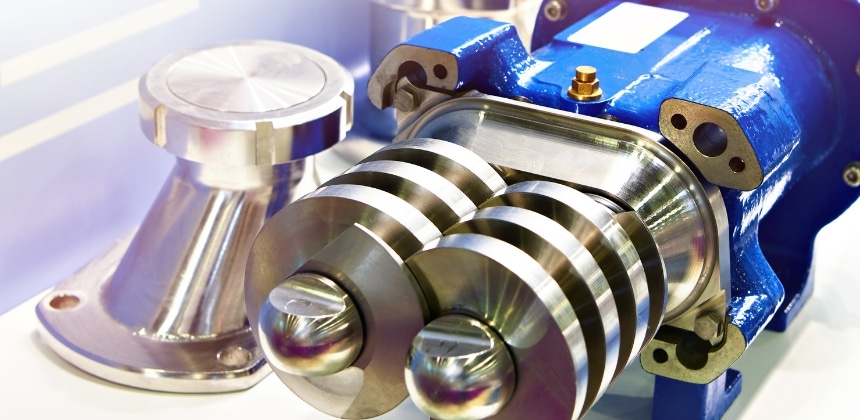
Twin screw pumps are positive displacement pumps in which two intermeshing helical screws rotate within a close-tolerance barrel, moving fluid axially along the screw profile from the suction end to the discharge end. The fluid is trapped in the sealed cavities between the screw threads and the barrel wall and displaced axially without passing through the screw mesh, which makes twin screw pumps particularly gentle on the fluid and capable of handling entrained gases, multiphase mixtures, and shear-sensitive products that other pump types cannot handle without damage.
Twin screw pumps are specified across demanding applications including:
- Oil and gas production: the handling of multiphase well fluids containing gas, oil, water, and sand without the separation and multiple single-phase pumps that conventional pump technology requires
- Food and beverage processing: the transfer of viscous and shear-sensitive products including sauces, dairy, beverages with pulp, and confectionery ingredients that must reach the filling point in the same condition as when the pump received the option
- Chemical and polymer processing: the metering and transfer of high-viscosity polymers, adhesives, and process chemicals whose flow characteristics change significantly with the shear rate that the pump applies
- Bitumen and heavy oil transfer: the handling of extremely high-viscosity products at elevated temperatures in refining and road construction applications
How are rotary gear pump manufacturers selected for industrial applications?
The selection of rotary gear pump manufacturers for a specific application requires evaluating the manufacturer’s ability to supply a pump designed for the specific fluid, viscosity, temperature, pressure, and flow rate requirements of the installation. Key selection criteria include the manufacturer’s experience with the specific fluid type, the material and seal options available for the fluid’s chemical and temperature compatibility, the manufacturer’s performance testing capability, and the availability of spare parts and service support for the installed lifetime of the pump.
Delta PD Pumps is a manufacturer of gear pumps, internal gear pumps, external gear pumps, and twin screw pumps for the chemical, petroleum, food, and industrial process sectors. As one of the specialist rotary gear pump manufacturers with engineering design and manufacturing capability in India, Delta PD Pumps supplies pumping solutions across a wide range of viscosities, pressures, and fluid compatibility requirements, with the technical support and application engineering that demanding industrial fluid handling applications demand.
